- Role
- Co-founder & CPO — product planning and design, the project plan, and the fundraising story
- Team
- Three co-founders: David Harvey (CEO), Fernando Rabasco (CTO) and me. No employees, no office
- Timeline
- 2024 → 2025 · seven months of evenings and weekends, from idea to demo, deck and investor conversations
- Stack
- Figma · Next.js + Tailwind · FastAPI + PostgreSQL · Vertex AI / OpenAI
- Links
- heyatmos.com
Screens come from our high-resolution prototype and the pre-seed deck, with demo data. The investors and practitioners who gave us feedback stay unnamed.
TL;DR
Atmos is the startup three hackathon teammates founded in 2024: software that helps small and mid-sized European companies produce EU-compliant sustainability reports (CSRD) without hiring an ESG team or a consultancy. As co-founder and CPO I led product planning and design end to end — research, personas, flows, a high-resolution prototype, the website and the pre-seed deck — and ran the project plan and the fundraising narrative alongside David. We applied to Y Combinator — and, when the EU rewrote the reporting rules for our customers in early 2025, chose not to pursue it. What we did get was a steady stream of positive feedback from climate-focused investors and recognition from people who write CSRD reports for a living. This is how it went from a Discord channel to a demo, and why we stopped where we did.
What we built
The demo, before the story
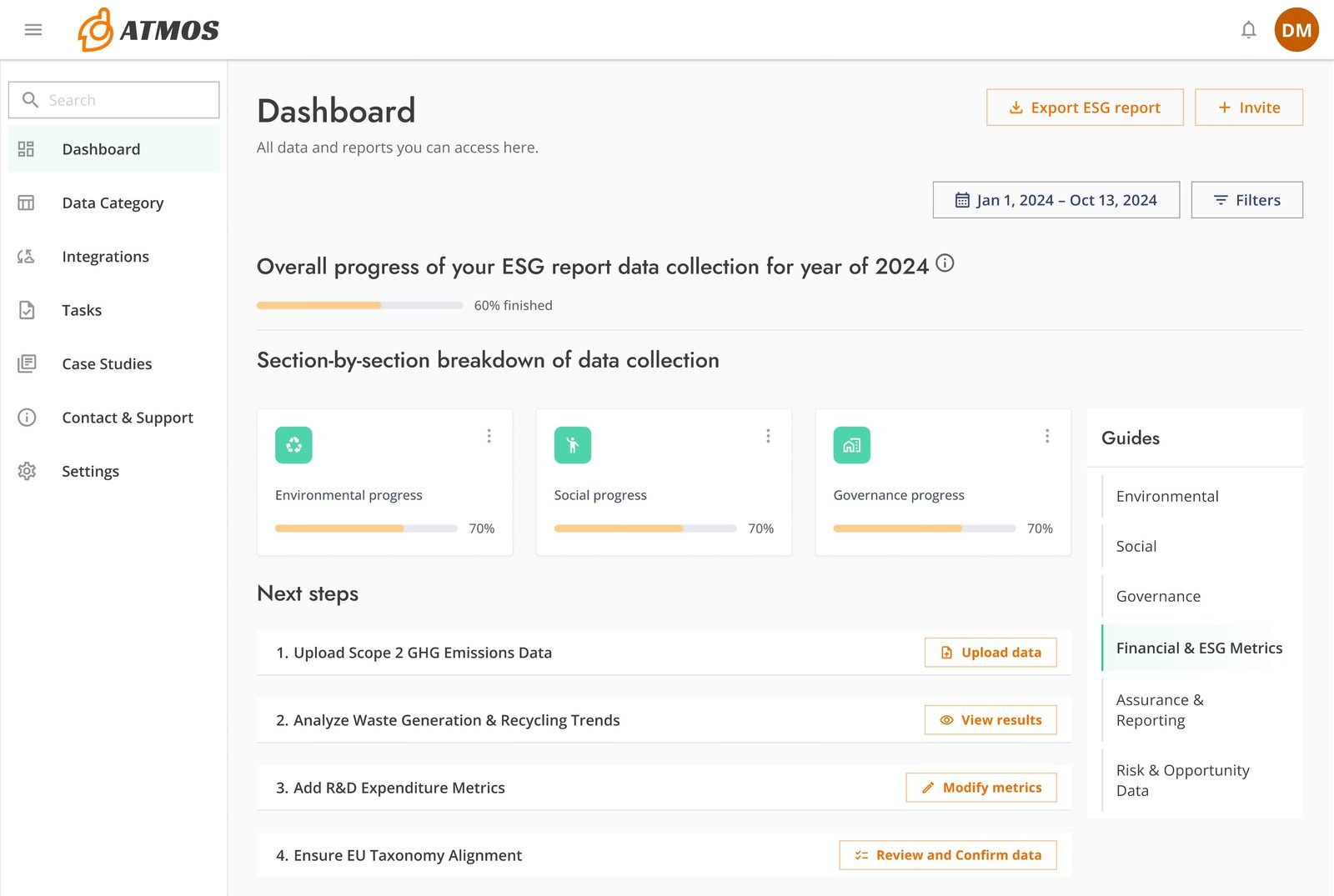
One dashboard, one question: what’s next?
Progress per ESG pillar, numbered next steps with the action attached, guides one click away. A CEO with no sustainability team should open Atmos and know what to do.
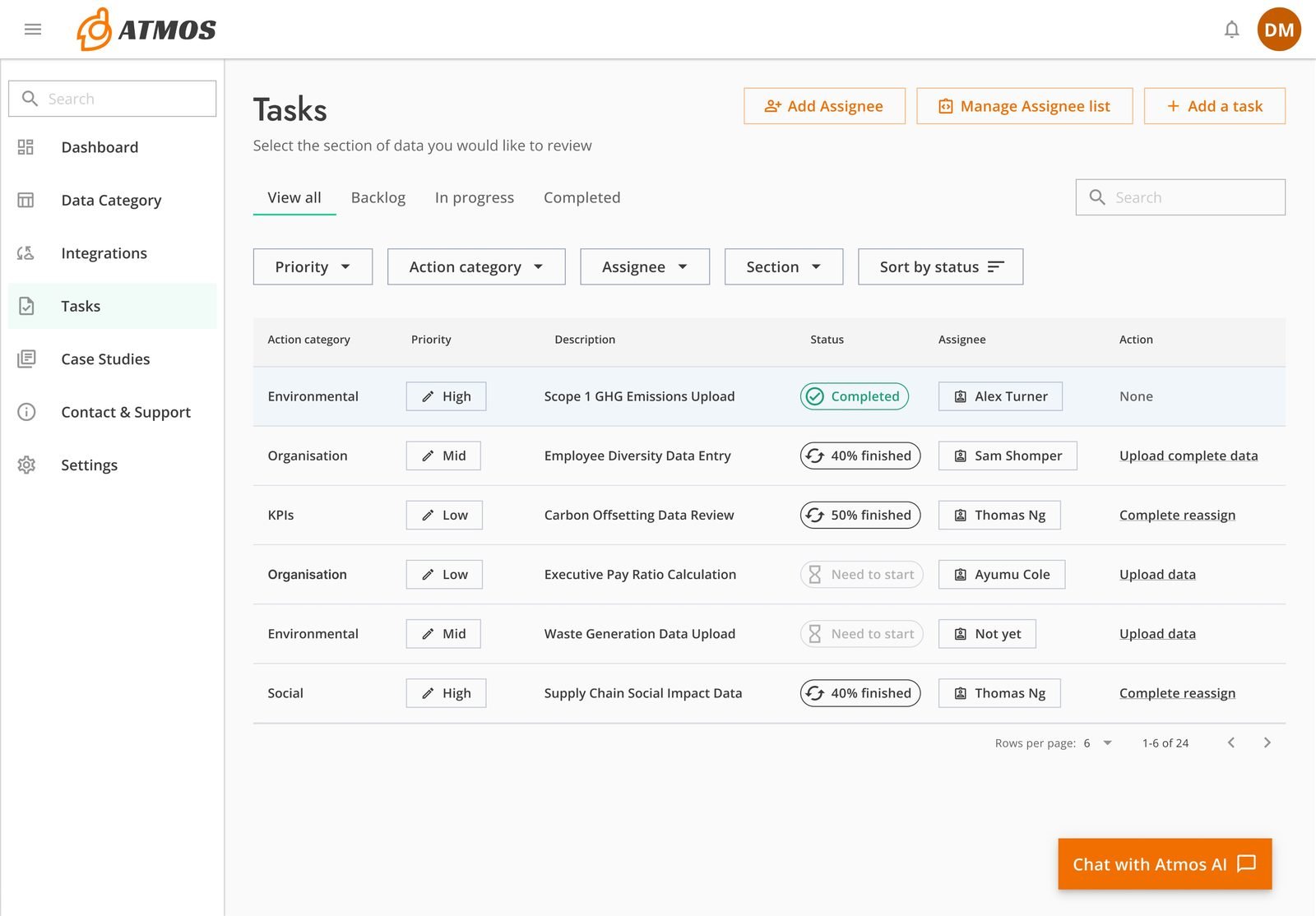
Reporting is a team sport
Tasks split the work across the company — assignee, priority, status, section. A practitioner taught us that reporting is a coordination problem before it is a knowledge problem.
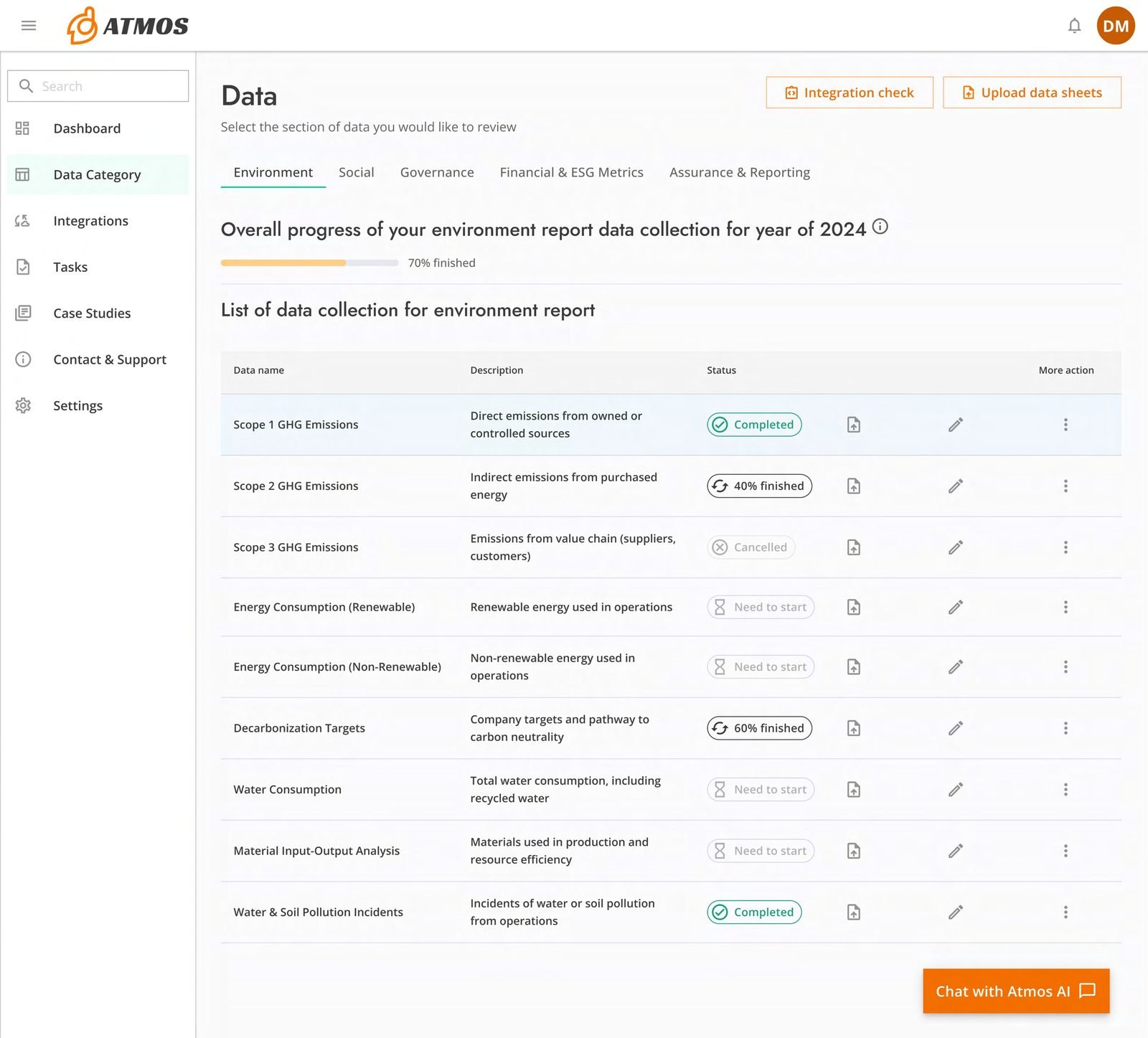
Data collection that follows the standard
Every ESRS data point has a description, a status and a place to upload. The report’s structure became the product’s structure.
Context
Three teammates, one deadline
We didn’t start with a market. We started with three people who had already shipped seven winning prototypes together.
David Harvey, Fernando Rabasco and I met in a Discord channel for web3 hackathons, then kept meeting in person — three hackathons across Europe, seven first prizes between us. The pattern never changed: pick a hard problem, split the work, ship in 48 hours. By 2024 the question was what we would build with more than a weekend.
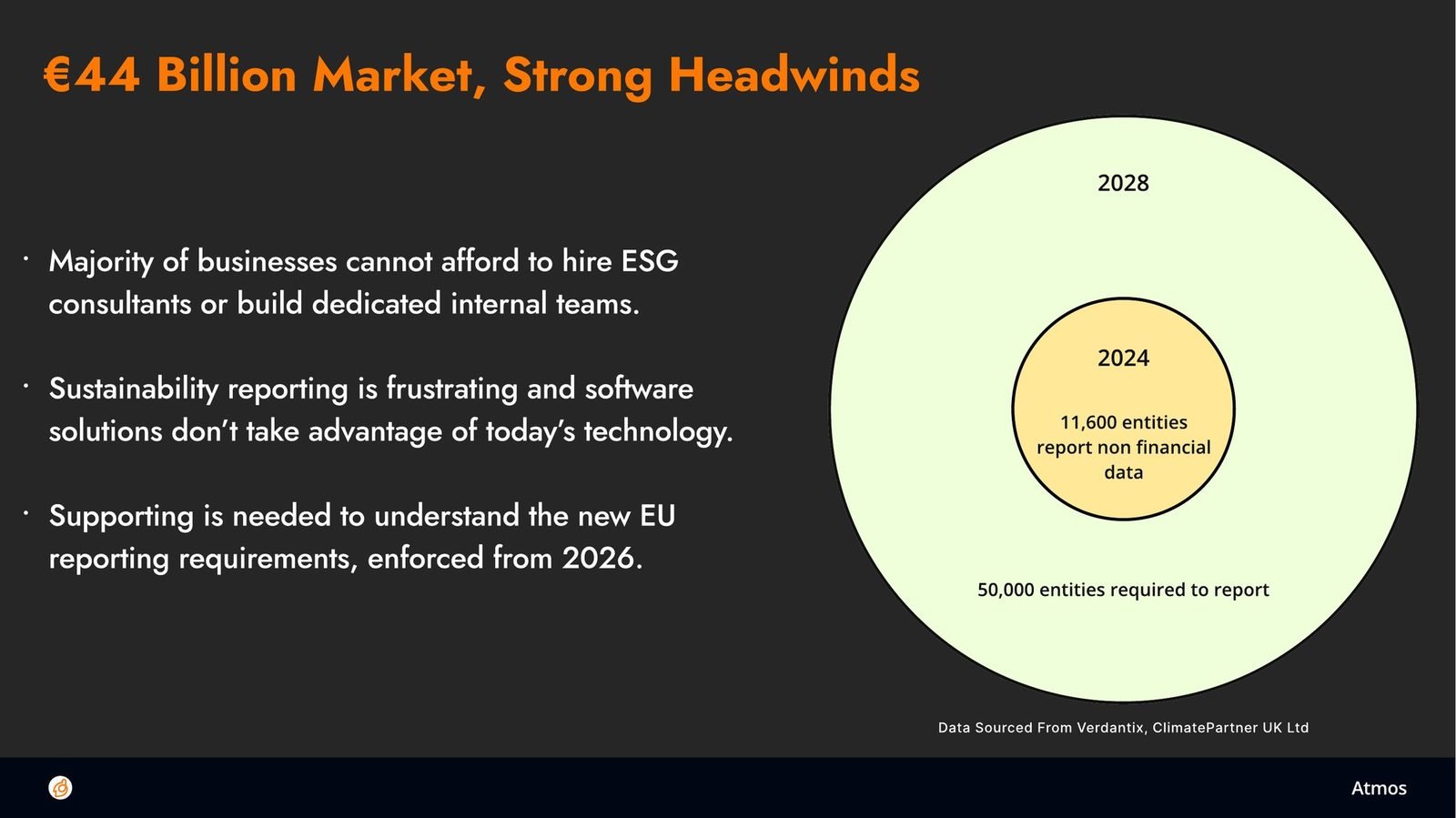
The answer came from a regulation. The EU was phasing in mandatory sustainability reporting — the Corporate Sustainability Reporting Directive — from large companies down to listed SMEs. Large companies have ESG teams and consultancies. The small and mid-sized businesses that make up 99% of EU companies have neither: the software was built for enterprises, and the consultants were priced for them too.
David Harvey · CEO
Strategy, partnerships and the investor conversations.
Me · CPO
Product planning and design, the project plan, and the story we told investors.
Fernando Rabasco · CTO
Architecture and code, from the FastAPI back end to the AI layer.
Research
Work backwards from the report
Before drawing a single screen, we wrote down the report we wanted the software to produce.
We read the CSRD and ESRS texts and studied published reports from Ørsted, Yara, Philips and AkzoNobel to see what “compliant” looks like on paper: twelve sections, a long list of data inputs behind each. Then we designed a simpler method for companies without a sustainability team — and that method became the feature list.
- Materiality firstPick the five to ten topics that matter for this business, and extract only the relevant parts of ESRS.
- Use what you haveUtility bills, HR exports, existing policies — data the company already tracks.
- Phase the hard partsScope 1 and 2 emissions first; Scope 3 and the supply chain later.
- IterateThe first report doesn’t have to be perfect. It has to exist.
Two hypothesis personas, modelled on real companies, framed the research: a head of sustainability at Catawiki, stuck on Scope 3 emissions from shipping auctioned objects, and an ESG officer at Busuu measuring the footprint of its cloud infrastructure. The competition — climate-accounting software, Microsoft’s Emissions Impact Dashboard, consultancies — wasn’t built for a 150-person company.
Product design
A guided path to a compliant report
Four steps, in the order a small company actually experiences them.
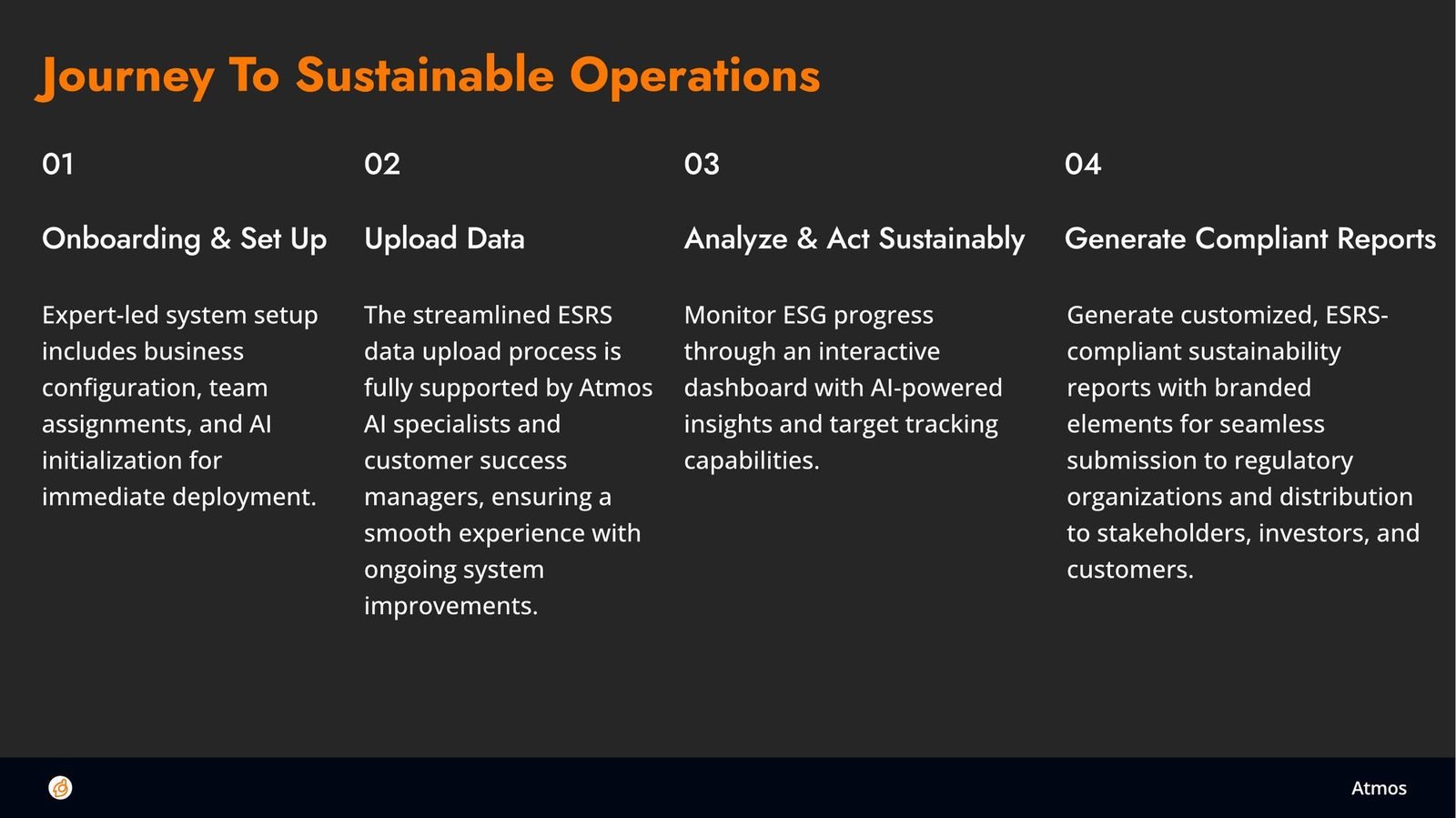
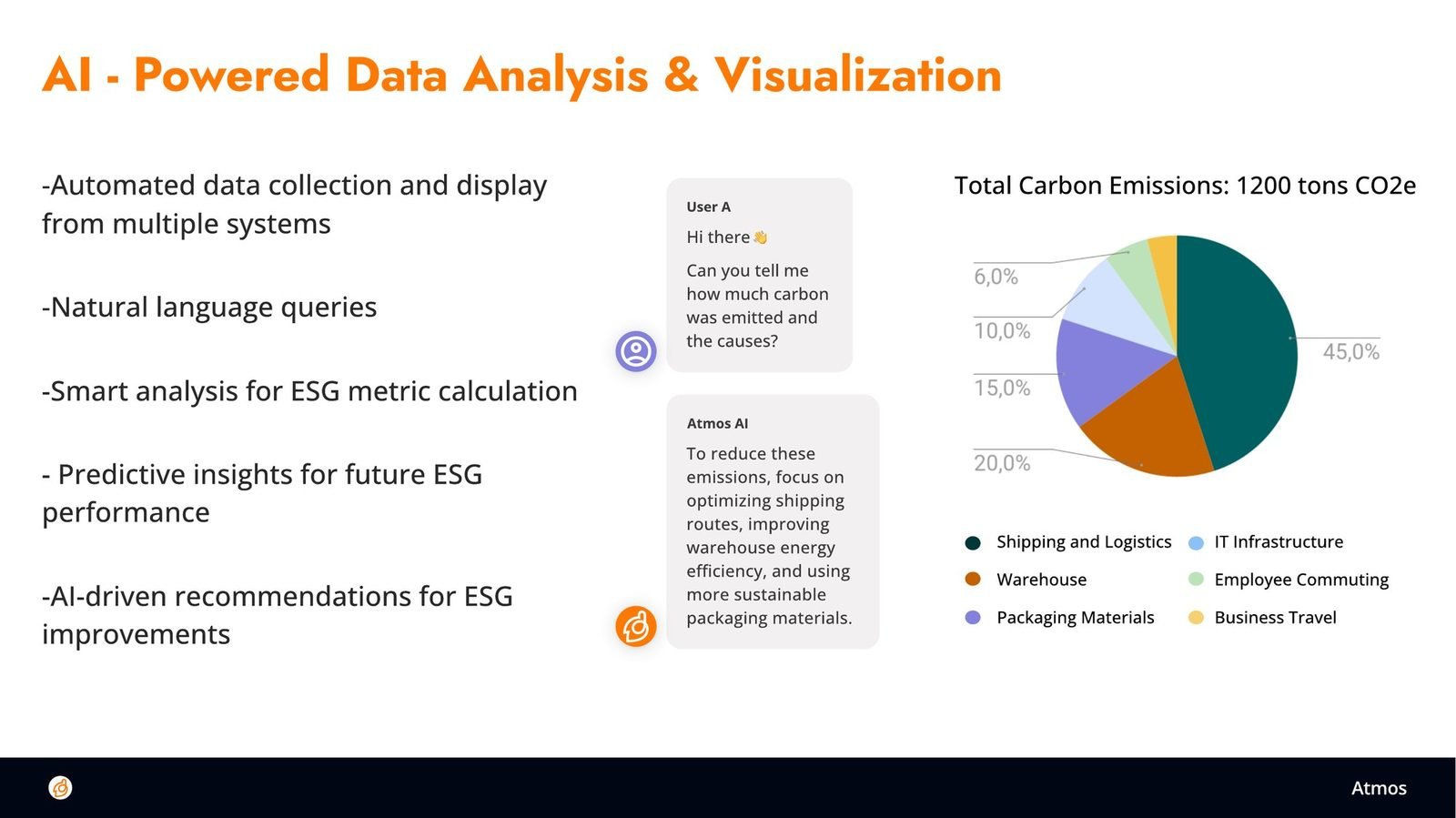
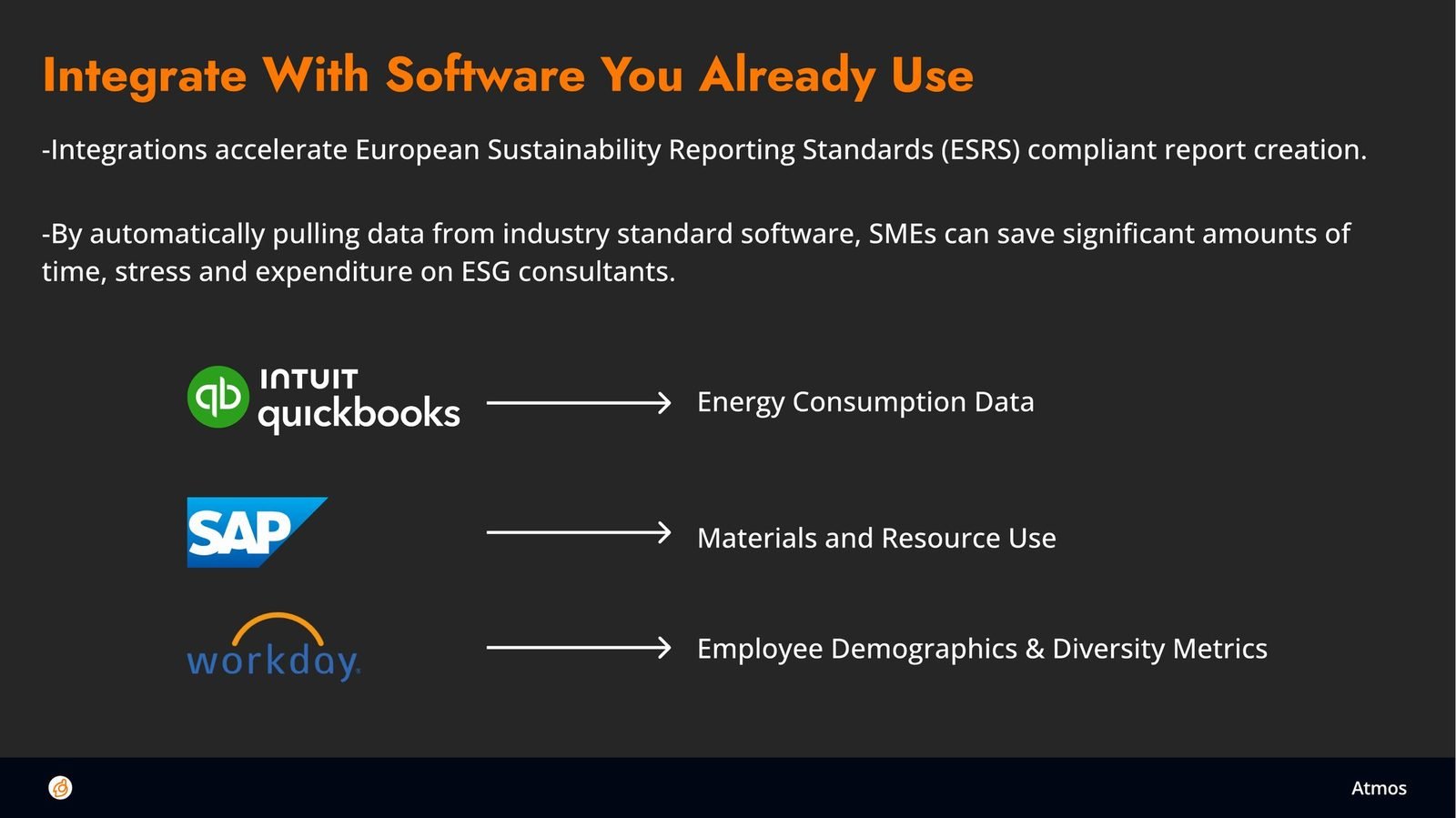
The dashboard, tasks and data screens above carry the first three steps. Two more ideas did the heavy lifting. Integrations made “use what you have” real: QuickBooks for energy, SAP for materials, Workday for workforce demographics — data pulled in instead of typed in. And AI sat where a consultant would: ask in plain language how much carbon you emitted and why, get a chart, a breakdown and recommendations for the next report.
We deliberately didn’t build an MVP first. A high-resolution Figma prototype, a demo video and a live website were enough to test the story with real people before a line of production code; user tests on the clickable prototype were the next step.
The pitch
A deck that opened doors
The deck wasn’t only an ask for money. It was the fastest way to find out whether the idea held.
Fourteen slides: why now, a €44 billion ESG-services market by 2028, what Atmos looks like, pricing at a fraction of what a company saves on consultants, and the road from customer discovery to product-market fit. I planned and designed it with David; every number came from the research above.
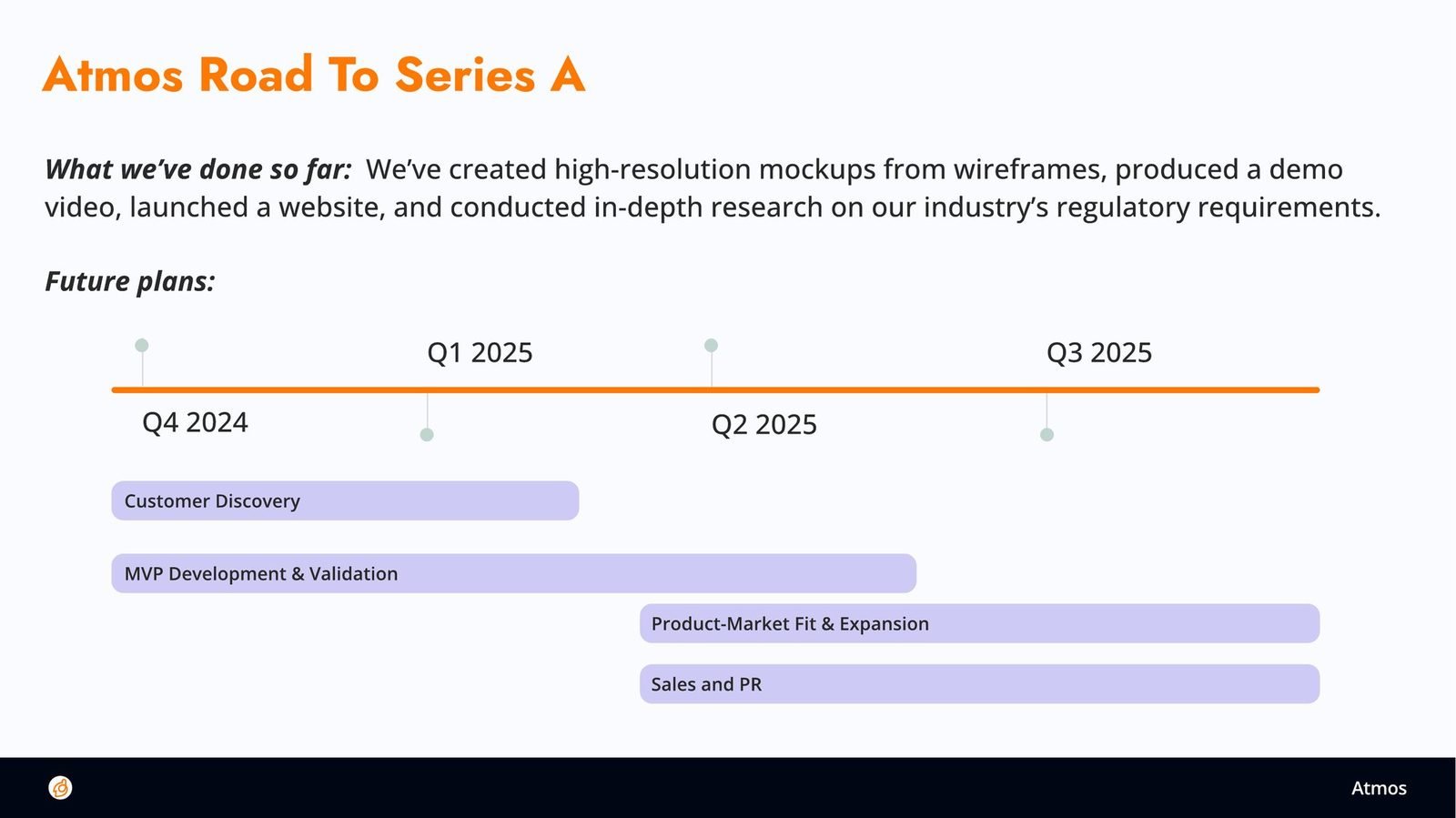
Two months in, we applied to Y Combinator with it. The application forced us to write down every assumption, and it became the best planning document we had. Then doors started opening: David was invited to YC’s Startup School Europe in London, conversations at Devcon turned into incubator introductions at Santander and Protocol Labs, and we began product discovery with an ESG manager at Allianz.
The CPO hat
What a CPO does in a company of three
In a team of three every hat is shared, but someone has to own the product, the plan and the story. I owned all three.
- Product: research → personas → flows → high-res prototype → demo video → website copy → deck design.
- Plan: what we would show at each milestone — mockups, demo video, website, application, investor conversations — across seven months of evenings and weekends.
- Fundraising: with David — which numbers to lead with, which slide answers which investor question, and what to change after each round of feedback.
- Build: stack decisions with Fernando — Next.js and Tailwind, FastAPI and PostgreSQL, Vertex AI and OpenAI — so the design could become code without translation.
Where it landed
Why we stopped, and what we kept
In early 2025 the EU rewrote the rules for the very customers we had designed for.
The Omnibus package pushed CSRD deadlines back and took most small and mid-sized companies out of scope altogether — the SME that had to report next year suddenly didn’t. Staying with SMEs would have meant redesigning the product around a moving target, hiring regulatory experts and working much more closely with policy-makers. Moving up to large enterprises would have meant far more competition and far more fundraising pressure. For three people with full-time jobs, neither was an evenings-and-weekends decision, so we made it deliberately: we chose not to pursue Y Combinator. We did rebuild heyatmos.com around a free CSRD reporting toolkit early that year, to keep CSRD experts and consultants in the conversation.
Atmos never took investment and never charged a customer — by design. What it gave us was proof that the three of us could go from a hackathon table to a company-shaped thing: a researched problem, a product people recognised, a deck investors wanted to talk about. It is the clearest example of the work I like most — deciding what to build, why, and how to tell it — with nobody upstream to hand the decision to.
Reflection
What I took with me
Start from the artefact
Writing the report before the software gave us a feature list no brainstorm would have produced.
Talk to one practitioner early
One ESG manager’s week reordered our roadmap: coordination before charts.
A deck is a research tool
Every investor question was a hypothesis test. We got more learning per hour from pitching than from any survey.
What I’d do differently with AI today
- Let an agent read the ESRS texts and draft the data-input checklist per industry — the week we spent mapping it by hand would go into customer interviews.
- Turn the Figma prototype into a working demo with real data, so investor and practitioner feedback lands on behaviour rather than pictures.
- Prototype the “ask Atmos” assistant against a sample company’s utility bills and HR export before designing the dashboard around it.
Curious to know more?